
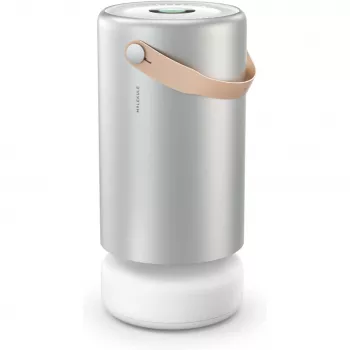
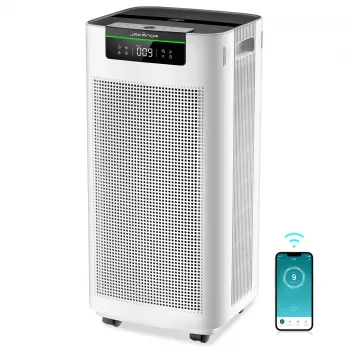
When a single room does a lot—living, working, cooking, hosting—air quality can shift fast. Our advanced air purifier is built for large spaces up to 1000 sq ft, combining a PECO-HEPA Tri-Power Filter approach for everyday particles, lingering odors, and the “mystery haze” that builds up in active homes. The goal is simple: cleaner air that keeps up with real life, not just quiet corners.
If you’re building a healthier indoor routine, it also helps to understand the basics of how air cleaners are evaluated and used in real homes. The U.S. EPA’s guidance on home air cleaners is a solid starting point (EPA — Guide to Air Cleaners in the Home), and AHAM’s overview of room air cleaner standards adds helpful context around performance terms (AHAM — Air Cleaner Standards and CADR). For a complementary strategy beyond filtration, the CDC’s ventilation recommendations can improve outcomes in stubborn spaces (CDC — Improving Ventilation in Your Home).
In practical terms, “Tri-Power” points to a multi-stage strategy. Instead of treating every indoor air issue as “dust,” the system is designed so different stages can address different categories of air problems you actually notice at home—particles you can see, allergens you can’t, and odors that tend to linger.
| Indoor issue | What it feels like at home | Filter strategy that typically helps |
|---|---|---|
| Dust & visible lint | Surfaces get dusty quickly, especially in high-traffic rooms | HEPA-grade particle capture |
| Pollen & outdoor allergens | Sneezing/itchy eyes after windows open or during peak seasons | Fine particle filtration (HEPA-grade) |
| Pet dander & fur | “Pet smell,” airborne fluff, and persistent allergens | Particle filtration + odor/VOC reduction stage |
| Cooking odors | Lingering smells after frying, spices, or fish | Odor/VOC reduction stage (often carbon/PECO-type) |
| General stale air | Room smells “used” even when clean | Combined particle + odor/VOC reduction approach |
Large-room coverage is most satisfying when you treat placement like part of the “system.” Even a powerful purifier can’t move air well if it’s boxed in, blocked by furniture, or tucked into a dead corner.
| Approach | Best for | Tradeoffs to consider |
|---|---|---|
| One large-room purifier (up to 1000 sq ft) | Open layouts, main living areas, multi-use great rooms | Less targeted control for closed bedrooms with doors shut |
| Two or more smaller purifiers | Homes with many closed rooms, different needs per room | More devices to place, power, and maintain |
No—using a large-room purifier in a smaller room can work well, and it may let you run at a lower fan speed for quieter day-to-day operation. Focus on clear airflow around the unit and consistent run time for the most stable results.
HEPA-style filtration is primarily about capturing particles like dust, pollen, and dander, while PECO-style technology is often positioned for reducing certain odors and VOC-related air concerns. A combined system is meant to cover both “stuff in the air” and some “smell/chemical” issues without relying on a single method for everything.
Follow the manufacturer’s recommended schedule, then adjust based on your real-world conditions like pets, cooking frequency, smoke exposure, and how dusty your home is. If you notice reduced airflow or odors that stop improving, it’s a good cue to check whether the filter needs attention.




Leave a comment